What is Behavioural Drift?
Behavioural drift is the gradual change in an individual's behavioural patterns from their established baseline. Carnegie Mellon CERT research shows that insider threat incidents are typically preceded by months of observable behavioural changes — stress elevation, disengagement, attitude changes — before any malicious action occurs.
Digital monitoring systems detect actions: data access, file transfers, login patterns. They cannot detect the behavioural precursors that research consistently identifies as preceding incidents. EchoDepth adds this human layer to insider threat programmes.
How does EchoDepth Defence detect behavioural drift?
EchoDepth Defence detects behavioural drift by comparing each person with their own baseline rather than with a population average. During an initial period of two to four weeks, the face engine builds an individual baseline from 44 FACS-compliant facial Action Units captured on standard RGB cameras. After that, it tracks sustained, statistically significant deviation in stress, engagement, suppression and cognitive load indicators, weighting patterns over time above one-off reactions to a single difficult day. A drift alert is a prompt for a trained analyst to review context. It is not an accusation and not an automated decision. The analyst decides whether the right response is welfare support, a conversation with a line manager, a change in monitoring posture or no action at all. Alerts can be passed to existing SIEM platforms via REST API, so behavioural drift sits alongside the digital indicators an insider threat programme already uses. Deployment requires explicit consent or specific legal authority, a DPIA and defined analyst roles.
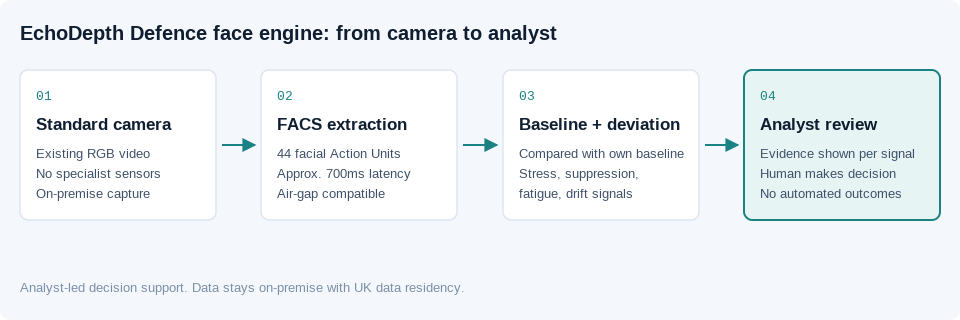
How Behavioural Drift Detection Works
EchoDepth establishes individual behavioural baselines from facial Action Unit patterns. Unlike population-average approaches, each individual's baseline is unique to them. The system then monitors for statistically significant deviations:
- Stress level changes — Sustained elevation in stress indicators
- Engagement pattern shifts — Changes in attention, focus and responsiveness
- Suppression frequency changes — Increased attempts to mask or control expressions
- Cognitive load variations — Changes in cognitive processing indicators
Why Individual Baselines Matter
People differ widely in how expressive they are. Some people show stress openly; others barely move their faces under pressure. A system that compares everyone with a population average will repeatedly flag naturally expressive people and miss changes in naturally reserved ones. That is both inaccurate and unfair.
An individual baseline asks a different question: is this person behaving differently from how they normally behave in this setting? It is designed to reduce the bias that comes from comparing people with each other, although no baseline removes the need to validate the system across the demographic groups in each deployment.
Digital Monitoring vs Behavioural Drift Detection
| Question | Digital monitoring (UEBA, DLP, SIEM) | EchoDepth Defence drift detection |
|---|---|---|
| What it observes | Actions: file access, transfers, logins, network activity | Changes in behavioural state relative to the person's own baseline |
| When it can signal | After a digital act has occurred | Potentially before any digital act, while behaviour is changing |
| Baseline | Per-user digital activity | Per-individual facial Action Unit patterns, built over 2 to 4 weeks |
| Typical response | Investigation of an event | Analyst review, often leading to welfare support or a conversation |
| Main strength | Evidence of what happened | Earlier, more supportive intervention |
The two are complementary. Digital monitoring shows what someone did; drift detection may show that something has changed for them first. Read more on the human layer of insider threat.
What Counts as Drift?
Drift is sustained change, not a bad afternoon. EchoDepth Defence aggregates signals over time so that one-off reactions carry less weight than a pattern that persists across days or weeks. Even sustained drift has many ordinary causes, including bereavement, illness, workload, financial pressure and changes at home. The analyst's job is to understand which applies, and the most common correct response to a drift alert is support, not suspicion.
Integration with Insider Threat Programmes
Behavioural drift detection is designed to complement, not replace, existing insider threat monitoring. EchoDepth integrates with SIEM platforms via REST API, feeding structured behavioural anomaly alerts into existing security workflows.
Drift alerts are not accusations. They are indicators that may warrant analyst review, additional support for the individual, or adjustment to monitoring posture. The goal is earlier intervention — supporting individuals before incidents occur, not just detecting malicious actions.
Legal and Ethical Considerations
Continuous behavioural monitoring requires explicit consent from monitored individuals, a deployment-specific DPIA, and appropriate governance structures. Cavefish does not deploy without all three. The platform is designed for transparent, consented use in high-security environments where such monitoring is lawful and appropriate.
Technical safeguards include pseudonymisation by default, role-based access, immutable audit logging of system operation and analyst actions, and fully on-premise processing with UK data residency. Monitored individuals should know that the system is in use, what it measures, and who reviews its output. See the governance framework and the continuous vetting guide.
Behavioural drift detection briefing
Technical briefings for insider threat programme managers, personnel security teams and security leadership. NDA available.