What is Behavioural Threat Intelligence?
Behavioural threat intelligence is the structured analysis of human behavioural signals in security-relevant contexts. Unlike emotion recognition, which attempts to label discrete emotional states, behavioural threat intelligence focuses on operationally significant patterns: stress indicators that may precede security incidents, deception signals during interviews or vetting, fatigue patterns in high-reliability operators, and behavioural drift from established baselines.
The human layer is the most significant variable in security operations, yet it remains invisible to most security infrastructure. SIEM platforms detect digital events. Access control systems track physical movements. Neither can see the cognitive and behavioural state of the people involved.
How Does Behavioural Threat Intelligence Differ from Emotion Recognition?
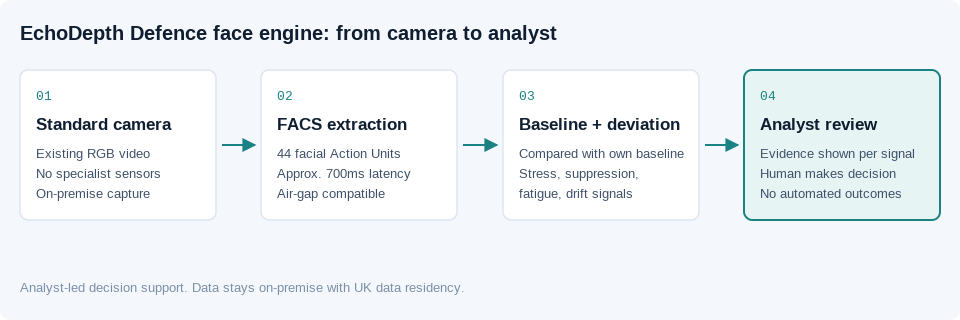
Behavioural threat intelligence differs from emotion recognition in what it outputs and in who decides. Emotion recognition attempts to label a person's emotional state, such as angry or afraid, usually automatically. Behavioural threat intelligence, as implemented in EchoDepth Defence, reports operationally relevant signals instead: stress indicators, suppression patterns, fatigue, cognitive load and drift from an individual's own baseline. These come from 44 FACS-compliant facial Action Units extracted per frame from standard RGB cameras, in approximately 700ms. Each signal carries a timestamp and a confidence weighting, and a trained analyst interprets it within operational context. The platform makes no automated decisions and does not classify people. The distinction matters legally as well as operationally. The EU AI Act restricts emotion recognition in workplaces and education, and UK GDPR treats biometric data as special category data. An analyst-led design, with on-premise processing and audit logging, is built to support a deployment-specific DPIA.
How EchoDepth Supports Behavioural Threat Intelligence
EchoDepth analyses FACS-compliant facial Action Units in real time using standard RGB cameras. It extracts 44 Action Units per frame, maps them to stress, suppression, fatigue and cognitive load indicators, and produces structured data for analyst-led assessment.
The platform is designed for human oversight, not automated decision-making. It provides structured signals that trained analysts interpret within operational context. This analyst-led approach is both more defensible and more effective than automated emotional labelling.
Two Engines: People and Narratives
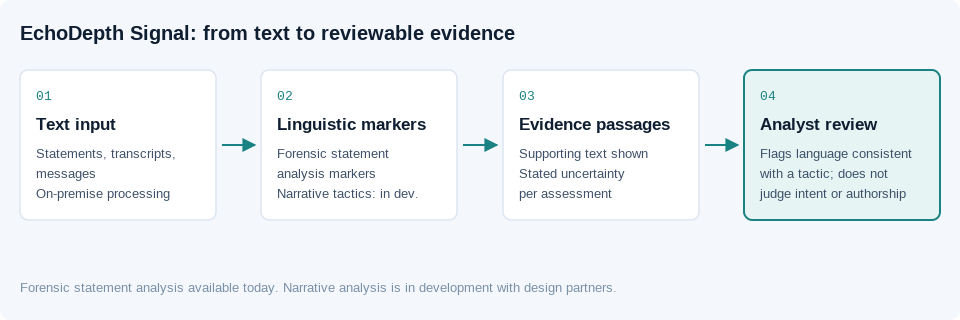
EchoDepth Defence has two engines. The face engine reads behavioural signals from people. EchoDepth Signal reads language: it already applies forensic statement and linguistic analysis to written statements, claims and transcripts, and it is being extended to narrative analysis of hostile messaging.
| Layer | Input | Output | Status |
|---|---|---|---|
| Face engine | Video from standard RGB cameras | Stress, suppression, fatigue, cognitive load and drift signals per frame | Available |
| EchoDepth Signal: statement analysis | Written statements, claims and transcripts | Linguistic markers with supporting passages and stated uncertainty | Available |
| EchoDepth Signal: narrative analysis | Hostile messaging across messages and channels | Language consistent with tactics such as intimidation, coercion, urgency and scapegoating | In development with design partners |
Narrative analysis flags language consistent with a tactic; it does not judge intent, attribute authorship or profile individuals. It is not part of the standard £35,000 proof of concept. See narrative analysis for the current programme.
Key Behavioural Threat Intelligence Capabilities
- Stress indicator detection — Elevated stress patterns that may precede security incidents
- Deception signal analysis — Suppression patterns, micro-expression timing, stress responses during questioning
- Fatigue and cognitive load monitoring — Operator readiness assessment for high-reliability roles
- Behavioural drift detection — Deviation from individual baselines over time
- Engagement and comprehension signals — Training effectiveness measurement
Deployment and Integration
EchoDepth deploys fully on-premise via Docker with zero external data transmission. It is SCIF-compatible and air-gap ready. Integration with SIEM platforms, C2 systems and LMS is available via REST API and WebSocket.
UK data residency is standard. All processing occurs within UK borders. The platform produces DSAT-compatible audit records and supports deployment-specific DPIA requirements.
Where Behavioural Threat Intelligence Is Used
- Insider threat: behavioural change that may precede an incident, alongside digital monitoring
- Credibility assessment: per-question stress and suppression mapping during interviews
- Operator readiness: fatigue and cognitive load in high-consequence roles
- Hostile intent assessment: structured signals for officers at borders and secure sites
The method behind all four is set out in the Behavioural Threat Intelligence Framework: collect signals lawfully, process them against individual baselines, require analyst review, integrate with existing security workflows, and govern the whole cycle. Most organisations begin with a scoped proof of concept, from £35,000, under NDA. See the procurement pathway.
Behavioural threat intelligence briefing
Technical briefings for defence procurement, security leadership and intelligence teams. NDA available.