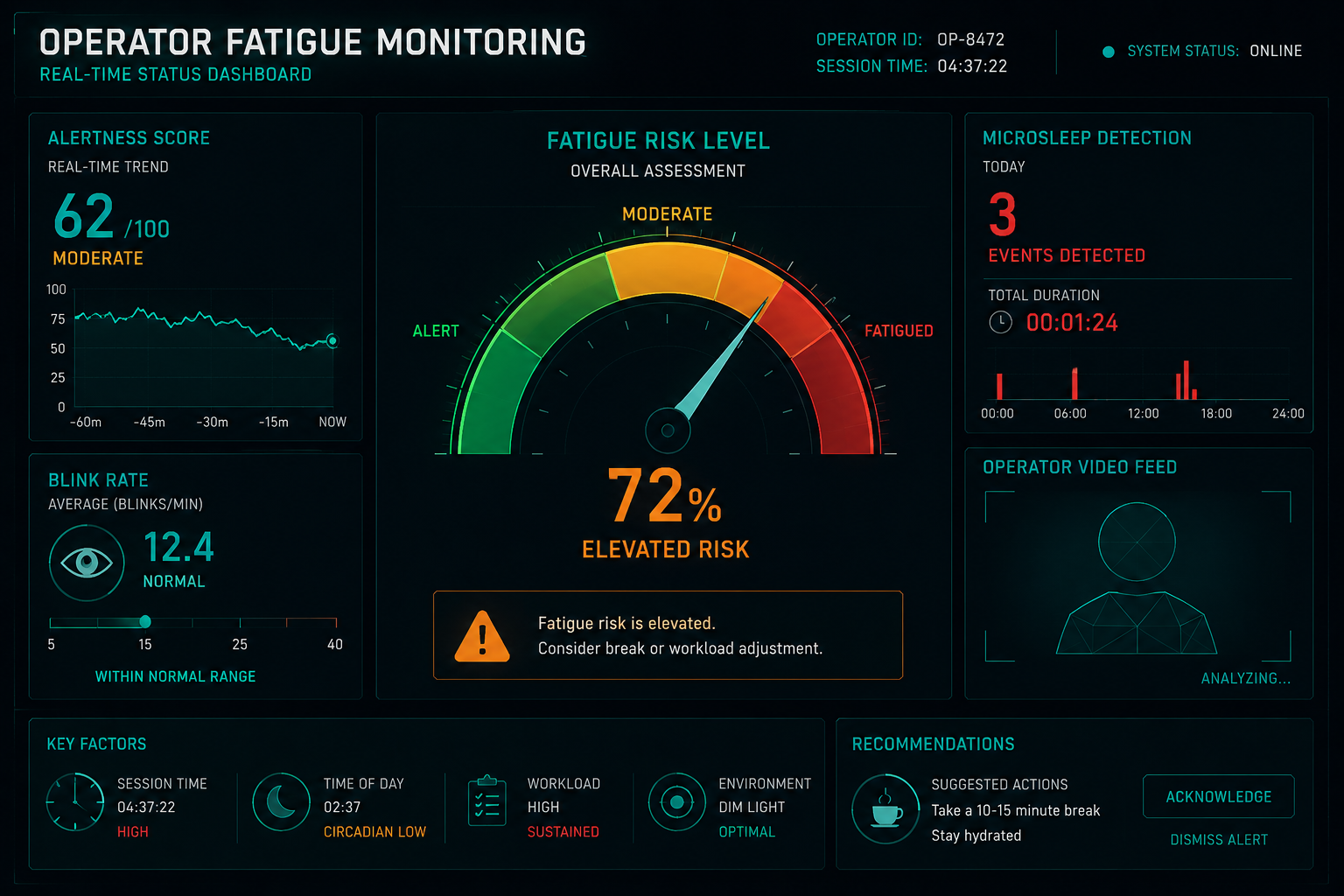
Operator fatigue is implicated in 21–23% of major military incident investigations, yet most organisations still detect it only by asking. Operator fatigue monitoring is the real-time assessment of cognitive and physical fatigue in personnel performing safety-critical tasks — UAS pilots, submarine crews, SOC analysts, control room operators and intelligence reviewers. Seven methods are in operational or research use: subjective scales such as the Karolinska Sleepiness Scale, biomathematical rostering models, actigraphy and wearables, heart rate variability, PERCLOS and oculometrics, EEG, and FACS-based facial Action Unit analysis. They divide on the axis that matters operationally — whether they observe the operator’s current state or infer it from history. Self-report and rostering models infer; HRV, oculometrics, EEG and facial analysis observe. Only the camera-based methods do so continuously without attaching hardware to the operator, which is why they dominate current defence interest.
How is operator fatigue monitored? Seven methods compared
| Method | What it measures | Operator burden | Continuous? | Evidence and limitations |
|---|---|---|---|---|
| Subjective scales (KSS, Samn-Perelli) |
Self-rated sleepiness at a point in time | None | No | Long operational history, but systematically under-reported where declaring fatigue carries career cost |
| Biomathematical models (SAFTE-FAST, FAID) |
Predicted fatigue from roster and sleep-history inputs | None | Predictive | Well validated for roster design; blind to the individual's actual state on the day |
| Actigraphy / wearables | Sleep duration and quality inferred from movement | Wrist-worn device | Retrospective | Good sleep estimation; weak indicator of acute cognitive state during a shift |
| Heart rate variability | Autonomic balance as an arousal proxy | Chest strap or wearable | Yes | Correlates with fatigue, but confounded by exertion, caffeine, hydration and emotional stress |
| PERCLOS / oculometrics | Percentage eyelid closure, blink duration and dynamics | Camera or eye tracker | Yes | The most extensively validated single camera-based index, established in driver-fatigue research |
| EEG | Cortical arousal — theta and alpha band activity | EEG cap | Yes | Closest thing to a reference standard for sleepiness; impractical to wear through an operational shift |
| FACS-based facial analysis (EchoDepth) |
44 Action Units including AU46 eyelid droop, blink rate and micro-expression frequency | None — existing workstation camera | Yes (~700ms) | Extends the PERCLOS approach across a wider Action Unit set; fatigue-specific validation base is younger than PERCLOS's |
An honest note on the last two rows. PERCLOS remains the most thoroughly validated camera-based fatigue index, with decades of transport-sector research behind it. FACS-based analysis measures PERCLOS-relevant signals (AU43/AU46 eyelid behaviour) alongside 40-odd other Action Units, which gives a richer picture of cognitive state — but the peer-reviewed base tying the wider AU set specifically to fatigue is younger and thinner than the PERCLOS literature. Where a single validated index is the procurement requirement, PERCLOS is the defensible choice. Where the requirement is continuous cognitive-state monitoring on existing hardware, the wider AU set earns its place.
Two further limits apply to every camera-based method here: the operator's face must be visible and adequately lit, and none of these methods measures sleep debt directly — they measure its downstream expression. A rostering model and a camera answer different questions, and mature fatigue risk management programmes use both.
Why Self-Report Fails as a Fatigue Detection Method
Operator fatigue monitoring is the real-time detection of cognitive and physical fatigue in personnel performing safety-critical tasks — such as UAS pilots, SOC analysts, and control room operators. Camera-based systems analyse facial Action Units (AU46 eyelid droop, blink rate, micro-expression frequency) to detect fatigue onset before self-report would capture it.
The standard approach to fatigue management in defence operations is the Karolinska Sleepiness Scale or equivalent self-assessment tool, administered pre-mission. Operators rate their perceived sleepiness on a numerical scale, and commanders make deployment decisions on that basis.
This approach has two fundamental weaknesses. First, social pressure in high-performing military units creates systematic under-reporting. Declaring fatigue is perceived as weakness or as grounds for being stood down from a mission — neither of which is attractive to motivated personnel. The incentive to under-report is strong, and it operates at exactly the moment when honest reporting matters most.
Second, moderate fatigue impairs the cognitive capacity to accurately assess one's own fatigue state. This is well-documented in the sleep science literature: people in states of moderate sleep deprivation consistently underestimate how impaired they are, because the metacognitive processes required for accurate self-assessment are themselves impaired. Research by Van Dongen et al. found that subjects with 14 days of 6-hour sleep restriction — equivalent to moderate chronic fatigue — showed stable subjective sleepiness ratings while their objective cognitive performance continued to deteriorate.
What Facial Signatures Does FACS Detect for Fatigue?
Fatigue has a consistent, measurable facial signature that appears before an operator's self-report would capture it. Key FACS Action Units associated with fatigue onset include:
- AU46 (wink/eyelid droop): increased frequency and duration as fatigue increases, caused by progressive weakening of the levator palpebrae superioris muscle
- Reduced blink rate: paradoxically, moderate fatigue often reduces blink rate before fatigue becomes severe
- Reduced micro-expression frequency: as cognitive resources are depleted, the frequency and amplitude of spontaneous facial expressions decreases
- Decreased arousal in VAD space: the Valence-Arousal-Dominance model captures the characteristic low-activation, low-engagement state of fatigued operators
- Reduced facial Action Unit diversity: fatigued faces show less AU variety — a measurable indicator that differs from the natural resting state
These signals appear, measurably, before an operator's subjective sense of fatigue becomes acute enough to prompt a self-report.
"Subjects with moderate sleep restriction showed stable subjective sleepiness ratings while their objective performance on the Psychomotor Vigilance Task continued to deteriorate across the restriction period."
— Van Dongen et al., Sleep (2003)How EchoDepth Implements Fatigue Monitoring
EchoDepth's operator readiness monitoring capability processes a standard RGB camera feed at approximately 700ms end-to-end latency. The pipeline extracts all 44 FACS-compliant Action Units per frame, maps them to VAD space, and computes a continuous readiness score relative to the individual's established baseline.
The readiness score integrates multiple signal streams: AU46 frequency and duration, arousal trajectory over time, micro-expression frequency, and blink rate deviation from baseline. This multi-channel approach is significantly more reliable than single-channel monitoring (such as pupillometry or heart rate alone), because fatigue affects multiple physiological channels simultaneously and the combination is harder to confound.
Fatigue alerts can be configured at two thresholds: a caution threshold that flags an operator for supervisor review, and a critical threshold that triggers automated stand-down recommendation. Both thresholds are configurable per role, per mission type, and per individual baseline — a UAS pilot's readiness requirements differ from a compliance training facilitator's.
How Is This Deployed in Operational Environments?
EchoDepth requires no new hardware in most operational environments. An existing CCTV camera, interview room camera, or laptop webcam at 720p minimum is sufficient. The system runs fully on-premise with no cloud dependency — suitable for SCIF and air-gapped environments. No sensors are attached to the operator at any stage.
For UAS operations, the camera can be positioned at the pilot's station. For SOC operations, existing desk cameras or facility cameras are used. For control room monitoring, existing CCTV infrastructure is typically sufficient. The system integrates with C2 platforms and alerting systems via REST API and WebSocket.
Pre-mission readiness scores are available as structured reports. Live session monitoring produces real-time readiness scores. Post-incident timeline reconstruction provides timestamped operator state data that can be reviewed alongside incident logs and system records.
The Role of Fatigue Monitoring in Human Reliability Assessment
Fatigue monitoring is a core component of Human Reliability Assessment frameworks. NATO STANAG requirements and JSP human factors guidance both identify fatigue as a primary performance-shaping factor for safety-critical operations. EchoDepth provides the real-time evidence layer that HRA frameworks assume but manual assessment processes cannot continuously generate.
DSAT-compatible audit records are produced as standard, providing the timestamped, structured evidence of operator state that incident investigation and performance review processes require.
Operator fatigue monitoring for UAS, SOC, and control room operations
Pre-mission readiness scoring. Live fatigue detection at 700ms latency. Post-incident reconstruction. No wearables. SCIF-compatible.