Sector

EchoDepth for
Border Force

Camera-based credibility assessment and stress detection for border interview environments. 44 FACS Action Units per frame. Non-contact. Structured legally-reviewable output. Deployable on existing interview room cameras.

Request a Briefing Download Procurement Guide

How Can EchoDepth Defence Support Border Force Credibility Assessment?

EchoDepth Defence supports Border Force credibility assessment by adding a structured, auditable record of behavioural signals to the officer's own judgement during an interview. It runs on the interview room's existing RGB camera, at 720p or above, with no sensors or physical contact, and extracts 44 FACS-compliant facial Action Units per frame in approximately 700ms. The output maps stress, arousal and suppression to each question, so an officer can see which questions produced a change and review the timeline afterwards. It does not decide whether someone is truthful, and it makes no decision about entry, detention or removal. Those decisions stay with the officer under existing legal process. Signals are indicators, not proof: anxiety, fatigue, language barriers, trauma and cultural differences can all produce stress, and officers are expected to weigh them. Processing is on-premise, with UK data residency, UK GDPR Article 9 safeguards and full audit logging.
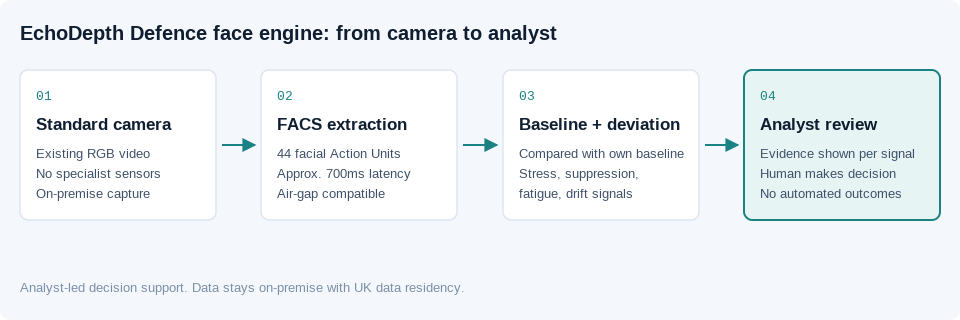
EchoDepth Defence face engine pipeline: a standard RGB camera feeds FACS Action Unit extraction, signals are compared with the individual's baseline to measure deviation, and a trained analyst reviews the result
Face engine: camera, FACS Action Unit extraction, baseline deviation, analyst review
Capability

Border Interview Credibility Assessment

Border interview credibility assessment relies on officer judgement — subjective, variable, and not producing an auditable record. EchoDepth provides an objective, continuous, structured supplement to officer assessment, using camera-based FACS analysis on existing interview room infrastructure.

What EchoDepth Provides During a Border Interview

  • ✓Continuous per-frame stress and arousal scoring throughout the interview
  • ✓Per-question stress spike detection — identifies which questions produce involuntary responses
  • ✓Suppression pattern detection — identifies attempted inhibition of emotional expression
  • ✓Micro-expression flagging — involuntary facial expressions lasting 1/25–1/5 of a second
  • ✓Timestamped structured JSON output with confidence weightings for audit trail
  • ✓Officer-facing alert when stress thresholds are exceeded

Deployment Requirements

  • ✓Standard RGB camera at 720p minimum — existing interview room cameras qualify
  • ✓No physical contact with or sensors on the subject at any stage
  • ✓On-premise server with Docker — no cloud connectivity required
  • ✓UK data residency as standard — all processing within UK borders
  • ✓REST API output for integration with case management systems
  • ✓Full audit logging meeting UK GDPR requirements for biometric data
Compared to Polygraph

No Contact. No Examiner. Auditable Output.

Polygraph requires physical sensors, a trained examiner, and produces a subjective report. Its false negative rate reaches 47% in controlled studies (NAS 2003). EchoDepth uses a camera already in the interview room, requires no specialist examiner, and produces a timestamped structured JSON record that can be reviewed, challenged, and included in case files.

Lie detector alternatives compared →
Legal Framework

Supporting Officer Decision-Making

EchoDepth output is explicitly positioned as a structured data supplement to officer assessment — not as a replacement for legal due process. It surfaces physiological correlates of stress and suppression for officer review. All biometric data is processed under UK GDPR Article 9 with appropriate lawful basis, DPA, and audit logging.

Discuss compliance requirements →

Officer Judgement With and Without EchoDepth Defence

EchoDepth Defence does not change who makes the decision. It changes what the officer has to work with, and what can be reviewed afterwards.

QuestionOfficer judgement aloneOfficer judgement with EchoDepth Defence
Who decidesThe officerThe officer; EchoDepth makes no automated decisions
What is recordedInterview notes and the officer's recollectionNotes plus timestamped per-question signal output in structured JSON
ConsistencyVaries between officers and across a long shiftThe same signal extraction for every interview
Contact with the travellerNoneNone; uses the existing room camera
Review and challengeDepends on notesThe signal timeline can be replayed, reviewed and challenged

Safeguards for Vulnerable Travellers

Border interviews include people who are frightened, exhausted, traumatised or speaking through an interpreter. All of these can raise stress signals without any deception. EchoDepth Defence deployments at the border should therefore include:

  • A rule that signals are never the sole basis for an adverse decision
  • Officer guidance on interpreting signals during interpreted interviews and with people who may have experienced trauma
  • Validation across the demographic groups relevant to the port or interview setting before live use
  • A deployment-specific DPIA, a signed Data Processing Agreement and defined retention periods

Most organisations begin with a scoped proof of concept, from £35,000 and typically 4 to 12 weeks, run under NDA. See the procurement pathway and the governance framework.

Request a Border Force Briefing

Technical briefings for UKBA/Border Force procurement and operational teams. NDA available. Live demo on request. Cardiff or remote.

Request a Briefing